About
About
Saravana Jaikumar is an Associate Professor of Marketing at IIM Calcutta who researches data-driven marketing and builds and advises on AI and machine learning systems.
- 835 citationsGoogle Scholar, h-index 14
- Seven to eight years in industryBefore the PhD, in India and the UK
- Many years at IIM CalcuttaTeaching, researching and supervising

Being a single father is at the heart of my identity, and it shapes how I see the work. My daughter is the reason I keep learning, and the reason I care whether any of this amounts to something beyond myself.
I am an Associate Professor of Marketing at the Indian Institute of Management Calcutta, and I work as an AI and machine learning consultant. I study how data, regulation and digital platforms shape what consumers and firms do. I also build the systems I teach about, and I help organisations decide where AI belongs in their work and where it does not.
What I do now
My time divides across three kinds of work.
I teach
Marketing and business analytics, AI and machine learning applications, marketing research and digital transformation, across the MBA, executive MBA, PGDBA and doctoral programmes. I also direct executive programmes, among them the Advanced Programme on AI for Leaders.
Teaching and programmesI research
Mostly data-driven marketing, business analytics and consumer welfare in emerging markets. Field work and natural experiments rather than opinion, and the comparison stated alongside the result.
Published researchI build and advise
For government bodies, large corporations and technology start-ups: AI and analytics adoption, digital marketing, pricing and revenue management, data-driven operations. Much of it is unglamorous. Small models for routine tasks, agents that run a defined process with a person at the decisive step, and the work of redesigning a process so the tool changes something.
Consulting work
The career arc
I did not start in a business school.
Mechanical engineering
PSG College of Technology
I trained as an engineer. It left me with the habit of asking how a thing is built before asking what it is worth.
First job
Tata Consultancy Services, India
A technical role, and a first look at how large organisations actually get work done.
MBA
Cardiff Business School, United Kingdom
Completed as University Gold Medalist.
Industry
Financial services and publishing, United Kingdom
Marketing analytics, digital marketing and marketing technology. This is where I learned what it is like to be the person responsible for a number other people rely on.
PhD in Marketing
Indian Institute of Management Ahmedabad
Seven or eight years in industry in all, across India and the United Kingdom, before I came back to India for the doctorate.
Assistant Professor
Indian Institute of Management Udaipur, 2015
The first academic post.
IIM Calcutta
From 2016, and Associate Professor since March 2023
Teaching, research, doctoral supervision and the executive programmes.
The arc is less of a detour than it looks. Engineering gave me a habit of asking how a thing is built. The industry years gave me a respect for operations. The PhD gave me a method for deciding whether something is true.
- Ph.D. (FPM, Marketing)Indian Institute of Management Ahmedabad
- MBACardiff Business School — University Gold Medalist
- B.E. Mechanical EngineeringPSG College of Technology
The research
Twenty-seven published papers, including work in the Journal of Marketing, which is on both the FT50 and the UTD24 lists. The methods are field experiments, quasi-experiments, event studies and choice modelling.
- Pharmaceutical price regulation and access to medicines
- Conspicuous consumption and income inequality
- Marketplace literacy at the base of the pyramid
- ICT-enabled development
- How consumers respond to AI and digital assets
835 citationsGoogle Scholar, h-index 14, i10-index 14
Funded by the Stigler Center at Chicago Booth, the Department of Science and Technology, the Global Development Network and the Ministry of Housing and Urban Affairs. Recognised with the PRME Faculty Excellence in Research Award.
See the papersHow the research and the building feed each other
The two halves of the work correct each other.
Research taught me
To distrust a result that arrives without a comparison
Much of my work asks what happened because of a policy or a platform, as distinct from what happened alongside it. The same habit shows up when I write about AI. If a vendor reports a gain, I ask what it was measured against. If an ad platform reports its own conversions, I ask for a holdout. It is the same question in a different setting.
Building taught me
What papers rarely say
A model that works on a benchmark can fail on a firm's own data. An agent that is technically sound can stall because nobody owns the process it changes. I have built a marketing system whose agents spend within a daily limit and ask above it, and a retail operations system of about fifty agents for RR Mart, a rural supermarket chain where I sit on the board. I have also fine-tuned a small model for a scientific publishing services firm: on 94 held-out queries it classified 88.3% correctly, against 63.8% for a prompt-only baseline. I trust numbers like those more than assertions, which is why I report them with the test they came from.
What I learn from these engagements goes back into the teaching cases and the executive programmes, so the classroom stays close to live practice.
How I work with organisations
Four things I hold to when I work with an organisation.
Start with the process, not the tool
Before anyone chooses a model, I want to see how the work is actually done: who does what, who approves, where it stalls. I would rather spend the first weeks with the people who do the work than with a vendor's demonstration.
Use the cheapest model that does the job
And test that claim on the organisation's own examples. For high-volume, repetitive tasks that often means a small model. For decisions where accuracy matters most, it means a stronger model and a person.
Put the limits in writing
Where an agent spends money or speaks for the firm, I set the threshold above which it must ask, and I name who may say yes.
Report what was measured
And keep measurement and opinion clearly apart. Where no outcome was measured, I say so rather than reaching for a number that sounds like one.
Past and current engagements include the Ministry of Housing and Urban Affairs, RR Mart, ThinkRisk, Edelweiss, Dr. Reddy's Laboratories and NCHMCT. I am a strategic advisor to MetaDecrypt AI Atlas.
Knowledge matters most when it empowers others, whether they are students, firms or communities. That is the thread through the teaching, the research and the building, and it is the thing I would want my daughter to find in the work.
Elsewhere
Where the work happens
Executive programmes for IIM Calcutta, mostly in Dubai. Photographs from my own programme archive.
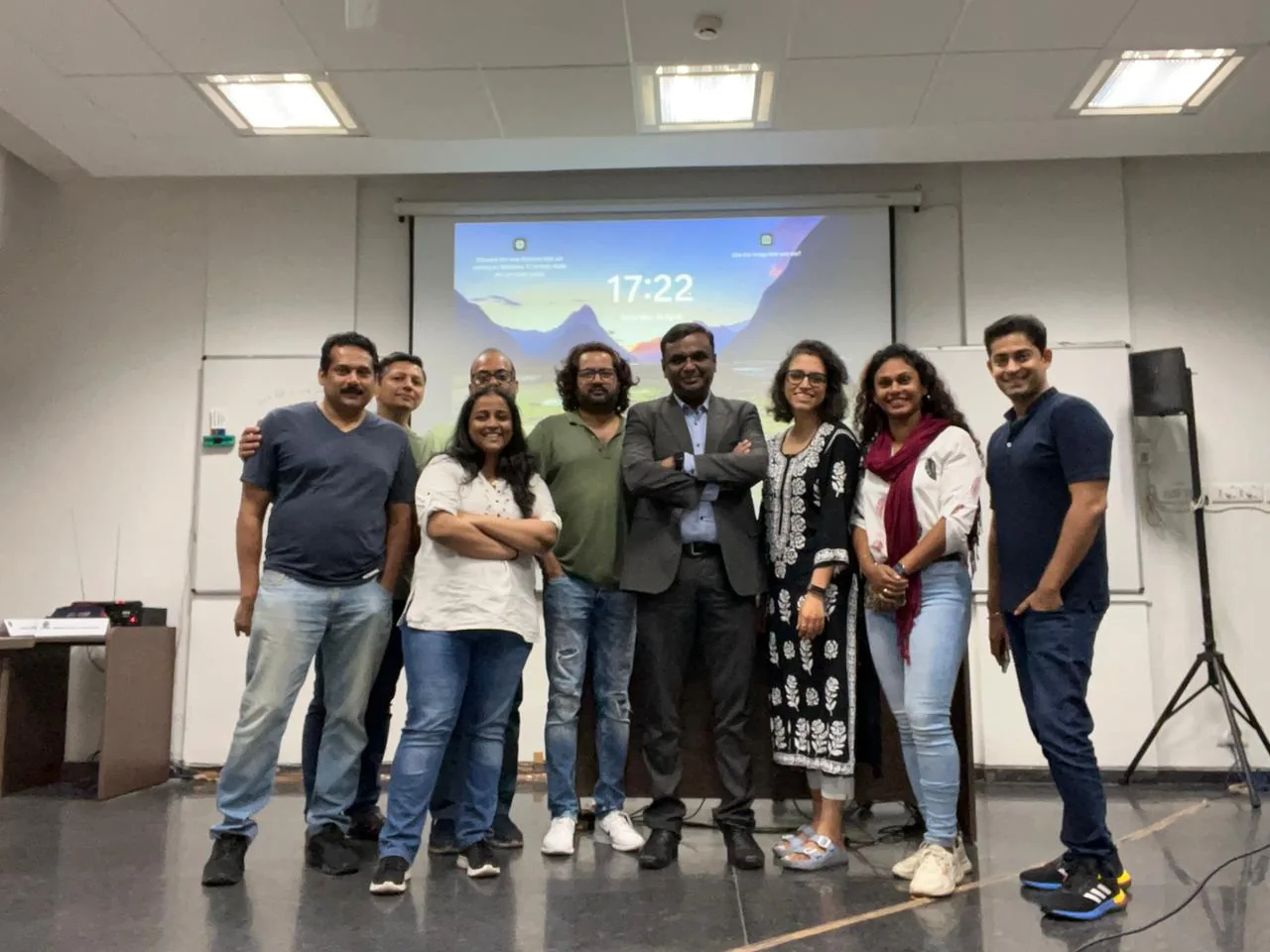
A Dubai cohort on the IIM Calcutta campus, April 2023. 
Mid-session in Dubai, May 2023. 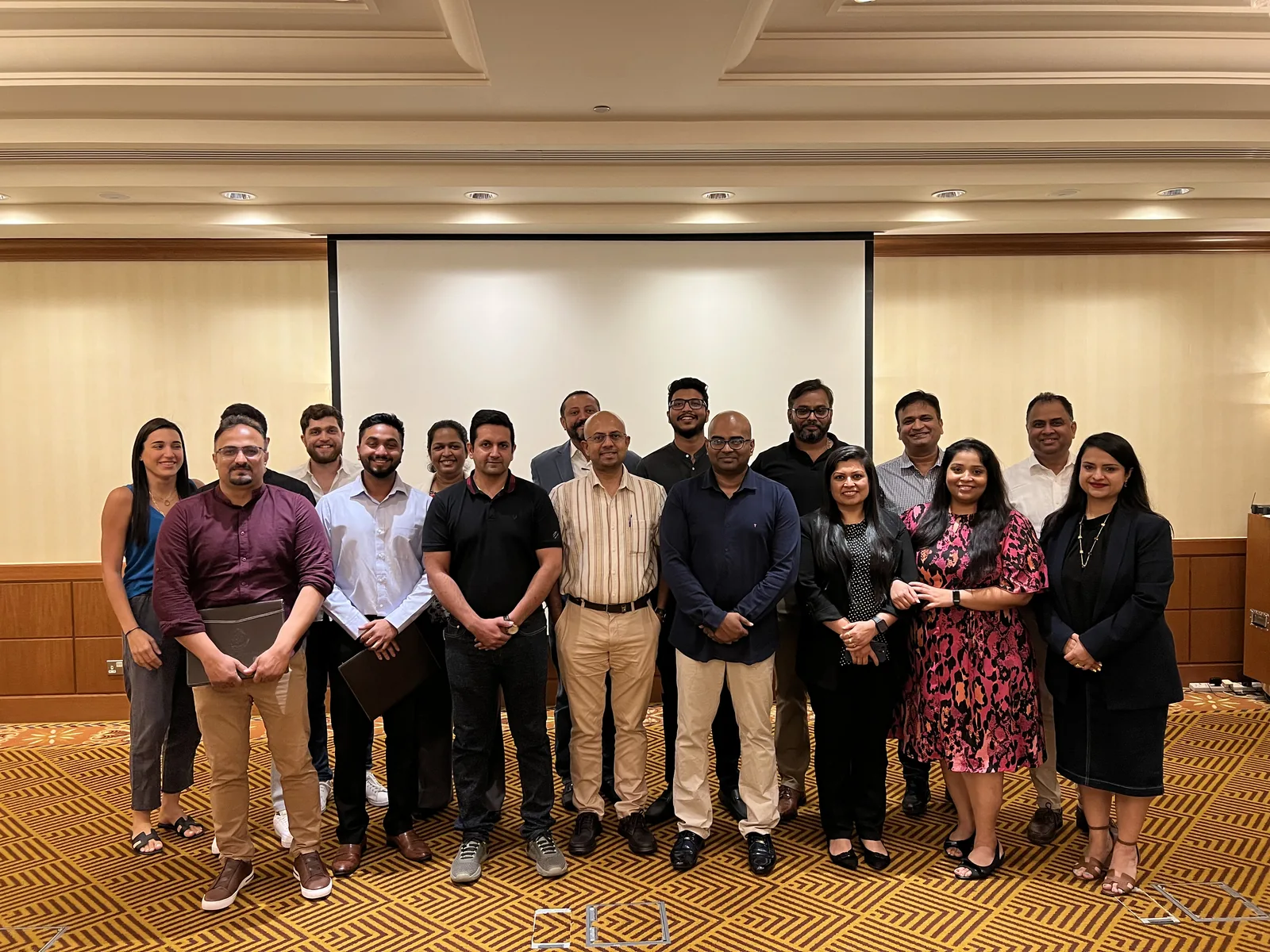
The May 2023 cohort, Dubai.